Project Head Start Was Designed to Provide Children From Low-income Families With

Caput Start is a plan of the U.s. Section of Health and Homo Services that provides comprehensive early childhood education, health, diet, and parent involvement services to low-income children and families. The programme's services and resources are designed to foster stable family unit relationships, enhance children's physical and emotional well-being, and establish an environment to develop strong cognitive skills. The transition from preschool to uncomplicated schoolhouse imposes diverse developmental challenges that include requiring the children to engage successfully with their peers outside the family network, adjust to the space of a classroom, and meet the expectations the school setting provides.[i]
Launched in 1965[2] past its creator and first director Jule Sugarman, Head Commencement was originally conceived as a catch-upwardly summer school program that would teach low-income children in a few weeks what they needed to know to start uncomplicated school. The Head Start Human action of 1981[three] expanded the plan.[four] The programme was revised and reauthorized in December 2007. Equally of late 2005[update], more than than 22 million children had participated. The current director of Head Kickoff is Dr. Bernadine Futrell.[5]
History [edit]
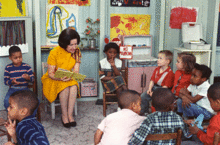
Head First began equally part of President Lyndon B. Johnson's Great Society campaign. Its justification came from the staff of the President's Council of Economic Advisers.[half-dozen] Stan Salett, civil rights organizer, national pedagogy policy adviser, and creator of the Upward Bound Program, is also credited with initiating the Head Start program.
Johnson started the War on Poverty shortly after President Kennedy's assassination. The murder shook the nation, and Johnson attempted to gain public trust past passing legacy legislation during the subsequent months. Johnson received an initial briefing from Walter Heller, who informed Johnson of Kennedy's poverty programme. By March 1964, the legislation, now known as the Economical Opportunity Act of 1964, had been prepared for Congress. The legislation included training, educational, and service programs for communities, including the Job Corps.[seven]
The Office of Economic Opportunity's Community Action Program launched Project Head Start as an eight-week summer programme in 1965. The program was led by Dr. Robert Cooke, a pediatrician at Johns Hopkins University, and Dr. Edward Zigler, a professor of psychology and director of the Yale Child Study Centre. They designed a comprehensive kid evolution program intended to help communities meet the needs of disadvantaged preschool children. The following year it was authorized by Congress as a year–round program. In 1968, Head Start began funding a television series that would eventually be called Sesame Street, operated past the Carnegie Corporation Children's Television set Workshop (CTW).
In 1969, Head First was transferred to the Office of Child Development in the Section of Health, Education, and Welfare (later the Department of Health and Human Services (DHHS)) by the Nixon Assistants. Today the program is in the Administration for Children and Families (ACF) division of DHHS.
In 1994, the Early Head Start plan was established to serve children from nascency to age three, in an attempt to capitalize on research testify that showed that the outset three years are critical to children's long-term development.
In the early years, some 700,000 children enrolled at a per-capita cost of $2,000 to $3,000 (2011 dollars). Under the full-fourth dimension plan, enrollment dropped to nether 400,000 by the early 1970s. Enrollment reached close to 1 million children past 2011.
Policy Quango [edit]
The Head Showtime Policy Council makes upward part of the Head Start governing body. Policy Council must be equanimous of two types of representatives: parents of currently enrolled children and community representatives. At to the lowest degree 51% of the members of this group must be the parents of currently enrolled children (see 45 CFR 1306.3(h) for a definition of a Head Start Parent). All parent members of the Policy Quango stand for election or re-election annually through private parent groups. Grantees/Delegates are required to provide proportionate representation to parents in all program options and settings. If agencies operate programs serving different geographical regions or indigenous groups, they must ensure that all groups being served volition have an equal opportunity to serve on the Policy Council. The Policy Council is required to encounter in one case each month. The term follows the federal government fiscal year, running November–November. Service on the Policy Council lath is limited to at nearly five one year terms.[8] The meetings are conducted in accordance with Robert'south Rules. The coming together solar day and time is agreed upon during the first meeting of the term year and may exist adjusted every bit needed.
The Policy Council blessing is needed for several program functions, from new hires to the program, as well as for the budget and spending. The Council can serve the program in ways that the others in the program cannot, as information technology is the only body that is part of Head Starting time that can exercise fundraising. In improver to monthly meetings, Policy Council may at times need to hold special or emergency meetings or take a phone vote. Policy Council representatives are required to attend classroom meetings and report back to the Policy Council with bug and needs of the classroom. They may also exist asked to sit down in on interviews every bit Head Beginning requires that a Policy Council representative exist present for all interviews. The officers of Policy Council include vice-chairperson, secretary, and vice-secretarial assistant. Classrooms are besides able to elect alternating Policy Council reps in example the master rep is unable to attend the meetings.
Services and programs [edit]
Head Start serves over ane one thousand thousand children and their families each year in urban and rural areas in all fifty states, the District of Columbia, Puerto Rico and the U.S. territories. Related health services include wellness screenings, health check-ups and dental check-ups. Family unit advocates aid parents in accessing community resources. All services are specific to each family unit's culture and feel. Head Showtime programs as well seek to support children's social emotional evolution.
Programs and services include:
- Early Caput Start promotes good for you prenatal outcomes, good for you families, as well every bit infant and toddler evolution beginning as early as birth.
- Head First helps to create healthy development and early childhood education in low-income children ages three to five.
- Family and Community Partnerships engage and support parents to identify and come across their ain goals, nurture their children, and abet for communities that support children and families.
- Migrant and Seasonal services are for children of migrant and seasonal farm workers. Service hours are longer and programs extend for fewer months than traditional Head Commencement.
- Head Start serves ethnic Americans with centers on reservations and in urban communities.[9] [x]
- Homeless children were included explicitly as subjects with the 2007 re-dominance.[11] Programs must identify and provide services to homeless children of all ages inside a reasonable menstruation. The McKinney-Vento Homeless Assist Act of 2001[12] also requires access to early childhood pedagogy such every bit Head Get-go for homeless children and families.
- Tri-Counties Regional Middle is one of twenty-one non-turn a profit regional centers in California providing lifelong services and supports for people with developmental disabilities residing in San Luis Obispo, Santa Barbara and Ventura Counties.[xiii]
- Early First is California's response to federal legislation ensuring that services to eligible infants and toddlers are coordinated and family-centered. It is a statewide system of early intervention services for infants and toddlers from nascence to 36 months of age. This program is coordinated past regional centers and public school districts.[14]
- Each eligible kid will exist assigned a Service Coordinator who will exist responsible for the coordination of early intervention services. Eligible children and their families may receive a diversity of early intervention services. Services for young children are family unit-centered, based on family concerns, priorities and resources, and provided in a child'southward natural setting. Services may include, but are not limited to:
- Infant stimulation (specialized instruction) in your dwelling house or community
- Physical, occupational and/or speech/language therapy
- Beliefs services
- Family Resource Centers for parent-to-parent back up[fifteen]
Eligibility [edit]
Eligibility is largely income-based, although each local programme includes other eligibility criteria, such as disabilities and services needed by other family members. Families must earn less than 100% of the federal poverty level.
| 2021 Federal Poverty Level[16] | |
| Family unit Size | Income |
| 2 | $17,420 |
| 3 | $21,960 |
| 4 | $26,500 |
| v | $31,040 |
| half-dozen | $35,580 |
| 7 | $40,120 |
| 8 | $44,660 |
The federal poverty line measure is accented and does not change from twelvemonth to twelvemonth, except to account for aggrandizement.[17] Families may likewise qualify under a chiselled eligibility category—receipt of Temporary Help to Needy Families (TANF) funds, Supplemental Security funds, or Homeless, as per the McKinney-Vento Human action. Upward to 10% of any funded programme's enrollment can be from higher income families or families experiencing emergency situations. All programs are required to provide services to children with disabilities, who must comprise 10% of their total enrollment. Per the Head Start Deed (2007), programs may elect to serve families whose income is between 100-130% under sure circumstances. Programs must also complete additional reporting requirements if this is appropriate for their community.
Military families stationed abroad, in Europe, the Pacific, and Cuba, can utilise for Sure Showtime.[18] Sure Start is the military version of Head Start and is overseen by the Section of Defence force Educational activity Activity.[19] There are four priority tiers for Certain Start, and like Head Start, not all eligible families are guaranteed a spot. The tiers are based on the sponsor's rank and become, E1-E4, E5, E6-E7, and lastly E8-E9.[xviii]
Budget and funding [edit]
The 2011 federal upkeep for Head Start was $viii.i billion. 85% was to be devoted to direct services and no more xv% on assistants, serving approximately i million students.
Local grantees must provide a xx% cash/in-kind match.[20] Each local grantee is required to obtain an almanac financial inspect, if it receives more than $500,000 in federal support.
Grants are awarded past the Administration for Children and Families (ACF) Regional Offices and the American Indian – Alaska Native and Migrant and Seasonal Program Branches directly to local public agencies, private organizations, Indian tribes and school systems.[21]
The individual Caput Start classrooms/centers "repay" the grant through a plan known as InKind. The Inkind program is a way to get their parents and their students working together on out of class studies.
Teachers [edit]
All pb teachers must take a bachelor's degree or be working towards one. Nigh have completed 6 or more than courses in early-childhood didactics.[22] By 2013, all teachers were to have associate degrees in a related field and half must have bachelor's degrees.[23] [24]
Equally of 2003, the boilerplate Head Showtime instructor made $21,000 per year, compared to the public school teacher average of $43,000.[25]
Teachers are also required to consummate a (CDA) Child Evolution Associate certificate.
Operations [edit]
While Head Start is a national programme, the implementation is upwards to individual states.[26] Head Start programs typically operate independently from local schoolhouse districts. Most ofttimes they are administered through local social-services agencies. Classes are generally small, with fewer than ten enrollees per adult staff member. Individual programs develop their ain academic and social curricula, following federal performance standards.[22]
Impact [edit]
Affections Taveras speaks about how Head Start changed his life every bit a child.
A 2020 study constitute that cohorts that attended Head Start had higher incomes and years of education as adults than similar children who did not attend.[27] A 2021 study found that the children exposed to more generous Caput Start funding had substantially improved test scores relative to children that were non exposed to generous Caput Beginning funding.[28] Another 2021 study constitute that students enrolled in Caput Start ended upwardly having substantially higher high school completion, college enrollment and college completion rates than comparable children who were not enrolled in Caput Offset.[29] The authors of the report concluded, "these estimates imply sizable, long-term returns to investments in means-tested, public preschool programs."[29] A 2009 study, which compared siblings, found that those who attended Head First showed stronger academic performance equally shown on test scores for years later, were less likely to be diagnosed every bit learning-disabled, less likely to commit crime, more likely to graduate from loftier school and nourish college, and less likely to suffer from poor health as an developed.[30]
In 2015, CCR Analytics, formerly Child Care Analytics, published the results of their Family Outcomes Survey completed by nearly xi,600 California Head Kickoff and Early Head First parents. xc% of parents surveyed said that Head Start helped them to become or continue a task. 92% of parents surveyed said that Head Beginning helped them to enroll in an educational or preparation program. 99% of families surveyed said that Head Start helped them to improve their parenting skills, such as responding to children's misbehavior and helping their children to larn. These results indicate that Head Offset has a positive impact on the whole family, beyond the individual children who attend the program.[31]
In 2014, CCR Analytics published the results of their study of 49,467 children assessed in the 2012–2013 school twelvemonth from 81 Caput Start programs throughout the country of California (more than 50% of the entire California Caput Commencement population). Participation in the report was open to all California Caput Start programs who used the DRDP-PS 2010 cess tool. The study plant that providing two years of Caput Start to a kid increases the probability past betwixt 13% to 86% that the child will meet age advisable expectations. Regression discontinuity blueprint was used to measure program bear on without denying a control group the opportunity to attend Head Start. The assay compared three-year-olds enrolled in Head Start to four-year-olds who returned to Head Start for their 2nd year. This too eliminated the upshot of selection bias because both groups chose to attend Caput Start equally 3-twelvemonth-olds.[32]
A randomized control study of the pre-k program serving socioeconomically disadvantaged children in Tennessee found brusk-term gains in language, literacy and math outcomes for pre-k participants compared with children who did not participate, which was likewise confirmed past a discontinuity assay (Lip, Farran, Bilbrey, Hofer, & Dong, 2011).
Lee collected data across 60 Head Start classrooms in 2007 and 2008. A sample of 1,260 children ages three to iv were selected equally the terminal sample. Of these children, 446 had entered Head Starting time at historic period 3 and enrolled for a twelvemonth (Group one); 498 had been entered at age iv and enrolled for a yr (Group 2); and 316 children had been enrolled for 2 years, entering at age 3 (Grouping 3). Academic issue measures in literacy, math and scientific discipline were collected based on the Head Outset and Early on Babyhood Programme Observational Checklist rating on a four-indicate scale (one—not yet to 4—excels. Family run a risk gene indicators (developed past the State Department of Education) included unmarried parent, unemployed parent, teenage parent, parental loss (divorce/death), low parental school achievement, nutrient insufficiency. Group 3 had higher literacy, math and science scores than the other groups. Children in the high-risk grouping had significantly lower literacy, math, and science scores than those who had three or fewer risk factors. Caput Start is associated with significant gains in test scores. Head Start significantly reduces the probability that a kid will echo a course.[33]
In 2002, Garces, Thomas and Currie used data from the Console Survey of Income Dynamics to review outcomes for close to iv,000 participating adults followed from childhood and compared with non-participant siblings. Among European Americans, adults who had attended Head Start were significantly more likely to complete high school, nourish college and possibly have higher earnings in their early twenties. African-American adults who had attended Head Start were significantly less probable to be booked/charged for a crime. Head Starting time may increase the likelihood that African-American males graduate from high school. Separately the authors noted larger effects for younger siblings who attended Head Start after an older sibling.[34]
In 1998, Congress mandated an intensive written report of the effectiveness of Head Start, the "Caput Start Impact Written report," which studied a target population of 5,000 iii- and 4-year-sometime children.[35] The written report measured Head First's effectiveness equally compared to other forms of customs support and educational intervention, as opposed to comparing Head Start to a nonintervention alternative. Head Start Impact Study Get-go Year Findings were released in June 2005. Study participants were assigned to either Head Start or other parent–selected customs resources for one year. 60% of the children in the control group were placed in other preschools. The first report showed consistent pocket-size to moderate advantages to 3-year-old children including pre-reading, pre-vocabulary and parent reports of children's literacy skills. No significant impacts were constitute for oral comprehension, phonological sensation, or early mathematics skills for either age grouping. Fewer positive benefits were plant for 4-year-olds. The benefits improved with early participation and varied beyond racial and ethnic groups. These analyses did not assess the benefits' durability.[36]
In 1976, Datta summarized 31 studies, concluding that the program showed immediate improvement in IQ scores of participating children, though nonparticipants narrowed the difference over time.[37] [ failed verification ] [38]
In 1975, Seitz, Abelson, Levine and Zigler compared disadvantaged children enrolled and not enrolled in Caput Start, using the Peabody Moving-picture show Vocabulary Test (PPVT). The participants were low-income inner-city blackness children whose unemployed, economically disadvantaged parents were considered unskilled. The Head Start children had attended for at to the lowest degree v months at the fourth dimension of testing, including nine boys and 11 girls. The non-enrolled group was on the Caput Start waiting list. The control group consisted of 11 boys and nine girls. The groups were matched by family income, parental employment and marital status. The tester tested children at home and in a school or office setting. The Head Start children scored higher than the controls in both settings, which suggested preschool intervention programs may take influenced the result. The controls tested at habitation scored the lowest, apparently due to anxiety from having an unfamiliar person in their homes. The Caput Start children were unaffected by the ecology gene. In evaluating this study vs. others, the relatively small sample size should be noted: 20 children vs. thousands in other studies.[39]
A 2005 review of the literature by Barnett and Hustedt plant "mixed, just by and large positive, evidence regarding Head Start's long-term benefits. Although studies typically find that increases in IQ fade out over time, many other studies also find decreases in course retention and special instruction placements. Sustained increases in school accomplishment are sometimes institute, merely in other cases flawed research methods produce results that mimic fade-out. In recent years, the federal government has funded big-scale evaluations of Head Get-go and Early Head Beginning. Results from the Early Head Start evaluation are particularly informative, as report participants were randomly assigned to either the Early Head Start group or a control grouping. Early Caput Starting time demonstrated modest improvements in children's evolution and parent beliefs and behavior."[40]
A 1995 inside–family assay compared subjects with nonparticipant siblings. Mothers who had themselves been enrolled in Head Start were compared to adult sisters who were not. Currie and Thomas separately analyzed white, black and Hispanic participants. White children showed larger and longer lasting improvements than black children.[41]
"Head Start Fade", in which pregnant initial impacts quickly fade, has ofttimes been observed, equally early on as 2d and third course.[42] [43] [44] Ane hypothesis is that the refuse is because Head First participants are probable to nourish lower-quality schools, which fail to reinforce Head Start gains.[42] Fryer and Levitt institute no evidence that Caput Start participation had lasting effect on test scores in the early years of school.[45]
A 2010 report past the Department of Health and Human Services, Head Showtime Touch on, examined the cognitive development, social-emotional development, and physical health outcomes of 4,667[22] three- and four-year-old children in a nationally representative sample of programs across 23 states. Children were randomly assigned to either a Head Start group (participants) or a non-Caput Kickoff group (control grouping). The children in the 2 groups were similar in all measured characteristics at plan entry. Pre-participation assessments of all critical issue measures were taken. Control grouping children optionally enrolled in non-Head Start programs. Most half of the control-grouping children enrolled in other preschool programs. Outcome measures covered cognitive development, social-emotional development, health condition and access to health intendance, and parenting practices. Head Beginning students were split into two cohorts – 3-year-olds with ii years of Head Start and 4-year-olds with ane yr of Head Beginning.[22] The study constitute:
- Participants showed positive effects in cognitive skills during their Head Start years, including letter-naming, vocabulary, letter-word identification and applied math bug,[22] although the "advantages children gained during their Caput First and age four years yielded only a few statistically pregnant differences in outcomes at the end of 1st grade for the sample as a whole. Impacts at the end of kindergarten were scattered. ... "[46] The gains applied to different skills beyond cohorts and grades, undermining generalizations nigh program impacts.[22]
- Participants showed fewer significant improvements in social and behavioral skills, even in the Caput Start year, with inconsistent results betwixt the three- and four-year-erstwhile cohorts. The four-yr-former cohort showed no meaning comeback in the Caput Start twelvemonth or kindergarten, but in tertiary grade, parents reported a pregnant reduction in total problem behavior and social and behavioral skills. Three-year-olds showed multiple, significant improvements in social and behavioral skills, but but for outcomes assessed by parents. Significant negative effects emerged in teacher relationships as rated past showtime-grade and third-grade teachers; and no significant positive effects for this accomplice were reported by teachers for any elementary year.[22]
- By the terminate of first grade, simply "a unmarried cognitive bear upon was found for each cohort". Compared to students in the control grouping, the 4-twelvemonth-old Head Commencement cohort did "significantly ameliorate" on vocabulary and the 3-twelvemonth-old cohort tested ameliorate in oral comprehension.[46]
- Caput Start had significant wellness-related effects, especially in increasing the number of children receiving dental care and having health-insurance coverage. These effects were not consistent, even so. For example, while participants increased health-insurance coverage, it did non extend into the 3rd-form yr for either cohort. Parenting practice changes were significant, only applied only to the iii-year-one-time accomplice. About related to discipline, such as reduced spanking or time-outs. The spanking outcome occurred did non last into the start grade. The pregnant effect on parental reading to children did not final into kindergarten.[22]
The HSIS study concludes, "Head Outset has benefits for both iii-twelvemonth-olds and iv-year-olds in the cognitive, wellness, and parenting domains, and for 3-year-olds in the social-emotional domain. However, the benefits of access to Head Start at historic period four are largely absent by 1st grade for the plan population as a whole. For 3-year-olds, there are few sustained benefits, although admission to the programme may pb to improved parent-child relationships through 1st grade, a potentially of import finding for children's longer-term evolution."[46]
According to the Administrative History of the Function of Economical Opportunity, children who cease the programme and are placed into disadvantaged schools perform worse than their peers by 2d course. Only by isolating such children (such as dispersing and sending them to improve-performing school districts) could gains exist sustained.[47]
In an op-ed slice in The New York Times, "Head Start Falls Further Behind", Besharov and Call discuss a 1998 evaluation that led to a national reevaluation of the program. The authors stated that inquiry concluded that the electric current program had little meaningful touch on. Even so, they did not cite master sources.[48]
In 2011, Time magazine's columnist Joe Klein called for the elimination of Head Start, citing an internal report that the programme is costly and makes a negligible touch on children's well-being over time. Klein wrote, "You take the 1000000 or and then poorest iii- and 4-yr-old children and give them a leg upwardly on socialization and education by providing preschool for them; if it works, it saves money in the long run past producing fewer criminals and welfare recipients ... it is now 45 years later. We spend more than $7 billion providing Head Beginning to nearly 1 million children each year. And finally in that location is indisputable evidence about the program's effectiveness, provided by the Department of Health and Human Services: Caput Start simply does non work."[49]
Westward. Steven Barnett, director of the National Constitute for Early Education Research at Rutgers University, rebutted Klein, "Weighing all of the evidence and non just that cited by partisans on one side or the other, the most accurate conclusion is that Head Start produces modest benefits including some long-term gains for children."[50]
Admission [edit]
There is not enough government funding to provide Head Kickoff for all eligible families, so to enroll in Caput Showtime, families must apply and and then be chosen.[51] In 2017, there were 1 one thousand thousand children enrolled in Caput Beginning and Early Head Start, merely there were nigh 19 million children nether five in the Usa and around 3 million children under 5 living in poverty.[52]
Head Start covers families living below the federal poverty line, but there 65% of children under the historic period of 6 having both their parents (or 1 parent, if they are a unmarried parent) in the workforce.[52] [53] Hotz and Wiswall'southward research found that for two-parent households, childcare is the almost expensive cost outside their rent or mortgage; in perspective, the median percent of income that goes towards childcare is thirty%.[52]
Meet also [edit]
- Arkansas Early Learning
- Compensatory Education
- HighScope
- Jenny Is a Good Matter, an Academy Award–nominated documentary on children and nutrition produced for Project Caput Start
- Projection STAR
- Southwest Human Evolution
- Certain Offset
- Upward Bound
References [edit]
- ^ McWayne, C. Thou., Cheung, K.; Wright, L.; Hahs-Vaughn, D.Fifty.; Thomas, D. (August 2012). "Patterns of School Readiness Amongst Head Kickoff Children: Meaningful Within-Group Variability During the Transition to Kindergarten" (PDF). Journal of Educational Psychology. 104 (three): 862–878. doi:10.1037/a0028884.
{{cite journal}}: CS1 maint: uses authors parameter (link) - ^ Currie, J.; Thomas, D. (1995). "Does Caput Start Make A Departure?" (PDF). American Economic Review. 85 (3): 341.
{{cite journal}}: CS1 maint: uses authors parameter (link) - ^ FDA. Memorandum of Understanding.
- ^ Gonzalez-Mena, Janet (2009). Child, Family, and Community (Fifth ed.). Pearson Educational activity. ISBN978-0135132302.
- ^ "ACF Home » Office of Head Start » About » Leadership". Administration for Children and Families. U.Southward. Department of Health & Human Services. May 16, 2018. Retrieved Nov 20, 2018.
- ^ Vinovskis, Maris A. (2005). The Nascence of Head Start . Academy of Chicago Press. pp. 36–37. ISBN978-0226856728.
- ^ Lyndon B. Johnson and the War on Poverty, archived from the original on May 16, 2015, retrieved April thirty, 2013
- ^ "Head Beginning Plan Functioning Standards Function 1301 — Program Governance". U.Southward. Section of Health & Human Services — Assistants for Children & Families . Retrieved May 1, 2020.
- ^ The Caput First Child Evolution and Early Learning Framework
- ^ "Archived re-create". Archived from the original on March 17, 2017. Retrieved March 16, 2017.
{{cite web}}: CS1 maint: archived copy equally title (link) - ^ NAEHCY
- ^ "Part C - Homeless Education". US Department of Didactics.
- ^ "Who We Are - Tri Counties Regional Center". tri-counties.org.
- ^ "Early Start Services - Tri Counties Regional Center". tri-counties.org.
- ^ "Services in the Early Start Programme - Tri Counties Regional Center". tri-counties.org. December 22, 2017.
- ^ "Federal Poverty Level (FPL) - HealthCare.gov Glossary". HealthCare.gov . Retrieved May 10, 2021.
- ^ "Across the Poverty Line (SSIR)". ssir.org . Retrieved May 10, 2021.
- ^ a b Communications, DoDEA. "Preschool". www.dodea.edu . Retrieved April 10, 2021.
- ^ "Sure First for Military machine Children". Military machine OneSource. March 12, 2021. Retrieved April 10, 2021.
- ^ Lubeck, Sally; DeVries, Mary; Nicholson, Julie; Mail, Jackie (July 1997). "Head Start in Transition". Early Education & Evolution. 8 (iii): 219–244. doi:10.1207/s15566935eed0803_2. ISSN 1040-9289.
- ^ Head Start factsheet, U.Southward. Department of Health and Human Services, archived from the original on January fifteen, 2010
- ^ a b c d e f thousand h "The Dubious Promise of Universal Preschool > Publications >". National Affairs. December 20, 2013. Archived from the original on April 8, 2014. Retrieved April viii, 2014.
- ^ Glod, Maria (November xv, 2007). "Bill to Expand Head Showtime, Bolster Its Teacher Qualifications Is Approved". The Washington Post . Retrieved June ten, 2013.
- ^ "Head Start Act Department 648A". Archived from the original on October 12, 2008.
- ^ "NIEER Fact Sheet on Head Commencement Teachers – July 2003". Archived from the original on Oct 27, 2008.
- ^ Burger, K. (April 3, 2012). "A Social History of Ideas Pertaining to Childcare in France and in the Us". Journal of Social History. 45 (iv): 1005–1025. doi:10.1093/jsh/shr144. ISSN 0022-4529.
- ^ De Haan, Monique; Leuven, Edwin (September 3, 2019). "Head Start and the Distribution of Long-Term Educational activity and Labor Market Outcomes". Journal of Labor Economics. 38 (3): 727–765. doi:ten.1086/706090. hdl:10852/74324. ISSN 0734-306X. S2CID 44049841.
- ^ Kose, Esra (2021). "Public Investments in Early Childhood Education and Academic Performance: Bear witness from Head Start in Texas". Journal of Human Resources. doi:10.3368/jhr.0419-10147R2. ISSN 0022-166X.
- ^ a b Bailey, Martha J.; Sun, Shuqiao; Timpe, Brenden (2021). "Prep School for Poor Kids: The Long-Run Impacts of Caput Start on Human Upper-case letter and Economic Self-Sufficiency". American Economic Review. 111 (12): 3963–4001. doi:10.1257/aer.20181801. ISSN 0002-8282.
- ^ Deming, D. (2009). "Early Childhood Intervention and Life-Bike Skill Development: Evidence from Head Start" (PDF). American Economical Journal: Applied Economic science. 1 (iii): 111–134. doi:x.1257/app.1.3.111.
- ^ "Family Outcomes Bulletin 2015". CCR Analytics.
- ^ "2014 Kid Outcomes Message".
- ^ Lee, K. (2011). "Impacts of the duration of Head Beginning enrollment on children's academic outcomes: Moderation effects of family risk factors and earlier outcomes". Periodical of Community Psychology. 39 (half dozen): 698–716. doi:x.1002/jcop.20462.
- ^ Eliana Garces; Duncan Thomas; Janet Currie (September 2002). "Longer-Term Effects of Head Start". The American Economic Review. 92 (4): 999–1012. CiteSeerX10.i.one.196.91. doi:x.1257/00028280260344560. S2CID 12458311.
- ^ Touch on report, U.S. Section of Health and Human Services
- ^ First year executive summary (PDF), U.Due south. Department of Wellness and Human Services
- ^ Datta, L. (1976). "The impact of the Westinghouse/Ohio evaluation on the evolution of project Caput Start: An exam of the immediate and longer-term effects and how they came about," In C. C. Abt (Ed.), The Evaluation of Social Programs (pp. 129–181)
- ^ Lee, V. East.; Brooks-Gunn, J.; Schnur, E.; Liaw, F. R. (1990). "Are Head Start Effects Sustained? A Longitudinal Follow-up Comparison of Disadvantaged Children Attending Caput Start, No Preschool, and Other Preschool Programs". Child Development. 61 (2): 495–507. doi:10.1111/j.1467-8624.1990.tb02795.x. PMID 2344785.
- ^ Seitz, V. Abelson, W., Levine, Eastward. & Zigler, Due east."Effects of identify of testing on the Peabody Picture Vocabulary Exam scores of disadvantaged Head Kickoff and not-Caput First children", Child Evolution, 1975
- ^ Barnett, W. Steven; Hustedt, Jason T. (January–March 2005). "Caput Start's Lasting Benefits". Infants & Young Children. xviii (i): 16–24. CiteSeerX10.1.ane.644.8716. doi:10.1097/00001163-200501000-00003. S2CID 7617558.
- ^ Currie, Janet; Thomas, Duncan (September 1998). "Does Head Offset Brand a Divergence?". American Economic Review. 85 (3): 341–364. doi:10.3386/w4406 . Retrieved May xiv, 2021.
- ^ a b Valerie E. Lee; Susanna Loeb (Spring 1995). "Where Practice Head Start Attendees End up? One Reason Why Preschool Effects Fade Out". Educational Evaluation and Policy Analysis. 17 (1): 62–82. doi:10.2307/1164270. JSTOR 1164270.
- ^ S. Barnett (1993). "Does Caput First Fade Out?". Education Calendar week. 5: 40.
- ^ Southward. Barnett (Winter 1995). "Long Term Effects of Early on Childhood Programs on Cognitive and Schoolhouse Outcomes". The Futurity of Children. 5 (3): 25–50. doi:10.2307/1602366. JSTOR 1602366.
- ^ Fryer; Levitt (2004), Understanding the blacK-white test score gap in the beginning two years of school (PDF), Academy of Chicago
- ^ a b c Weigel, Margaret (Baronial xi, 2011). "Caput Start Impact: Section of Health and Human being Services Report". Journalist'south Resource.org.
- ^ Administrative History of the Part of Economic Opportunity, Vol. I, p. 252, Box 1
- ^ Besharov, Douglas J.; Phone call, Douglas M. (February 7, 2009). "Head Start Falls Further Behind". The New York Times . Retrieved February 8, 2011.
- ^ Klein, Joe (July 7, 2011). "Time to Ax Public Programs That Don't Yield Results". Time. Archived from the original on July nine, 2011.
- ^ Valerie Strauss, "Does Head Outset work for kids? The bottom line", The Washington Mail service, March v, 2013.
- ^ "How to Apply | ECLKC". eclkc.ohs.acf.hhs.gov . Retrieved May x, 2021.
- ^ a b c Hotz, 5. Joseph; Wiswall, Matthew (2019). "Kid Care and Child Care Policy: Existing Policies, Their Furnishings, and Reforms". The Annals of the American Academy of Political and Social Science. 686 (1): 310–338. doi:10.1177/0002716219884078. ISSN 0002-7162.
- ^ Farquhar, Sarah‐Eve (January 1989). "Assessing New Zealand child mean solar day care quality using the early babyhood environment rating calibration (ane)". Early Kid Evolution and Care. 47 (ane): 93–105. doi:x.1080/0300443890470105. ISSN 0300-4430.
Farther reading [edit]
- Scott Stossel. Sarge: The Life and Times of Sargent Shriver, 2004, Smithsonian Books, Washington.
External links [edit]
US government—Assistants for Children & Families [edit]
- Official website

- Office of Caput Start
- Early Childhood Learning and Knowledge Center (official)
- Role of Regional Operations
Head Beginning Associations [edit]
- National Head Start Association
- New England Head First (Region 1)
- Region 2 Head Starting time
- Region Three Head Offset
- Region Four Caput Showtime
- Region V Head Starting time
- Region VI Caput Kickoff
- Region 7 Head Kickoff
- Region Eight Caput Start
- Region 9 Caput Start
Full general Information [edit]
- The Head First Experience
- Read Congressional Enquiry Service (CRS) Reports regarding Head Start
- The Center for Law and Social Policy
- National Bureau of Economical Research
- Cyberspace Periodical documentary "Caput Start in Mississippi" from 1967 at the American Archive of Public Broadcasting
dowlingquainged37.blogspot.com
Source: https://en.wikipedia.org/wiki/Head_Start_(program)
0 Response to "Project Head Start Was Designed to Provide Children From Low-income Families With"
Post a Comment